
Four Hours Before the Drain Van Arrives: My Prep Routine for a Desentupidora in Santa Efigênia
Before I call a desentupidora Santa Efigênia São Paulo SP, I do four hours of prep. Not because the crew needs me to, but because a prepared site cuts diagnostic time in half. The first thing I get ready is access: a clear path from the street to the affected drain, the building’s water shutoff location, and a written note of when the backup started.
Search intent here is practical: people want to know what to have ready so a technician can start fast. I treat it like a pre-flight checklist, and the routine below is exactly what I did the last time a restaurant on Rua Martim Francisco backed up during lunch service.
What I gather before the crew rings the bell
I start with the physical layout. In Santa Efigênia, many buildings are old and the original blueprints are gone, so I sketch the visible cleanouts and the route from the kitchen or bathroom to the street. That sketch saves the technician from guessing where the blockage sits.
Next I collect the history. When did it start, does it repeat, and does it happen only when multiple fixtures run at once? A recurring backup at the same fixture usually points to a partial obstruction, not a total clog, and that changes which tool the crew brings first.
I also note what has already been tried. If someone poured chemical drain cleaner down the line, I say so, because it affects safety and the cleaning method. I never hide a failed DIY attempt.
Access and safety items on my list
- Keys to the utility room, garage, and any gated cleanout area.
- A flashlight and a rag to wipe the cleanout cap before opening.
- Cardboard or old towels to protect the floor around the drain.
- The building manager’s phone number, in case the shutoff is in a shared area.
- A note of any tenant with mobility issues who needs warning about water being off.
I keep this kit in a plastic box near the service entrance. When the crew arrives, they do not wait while I search for a key.
The job itself, in the order it happened
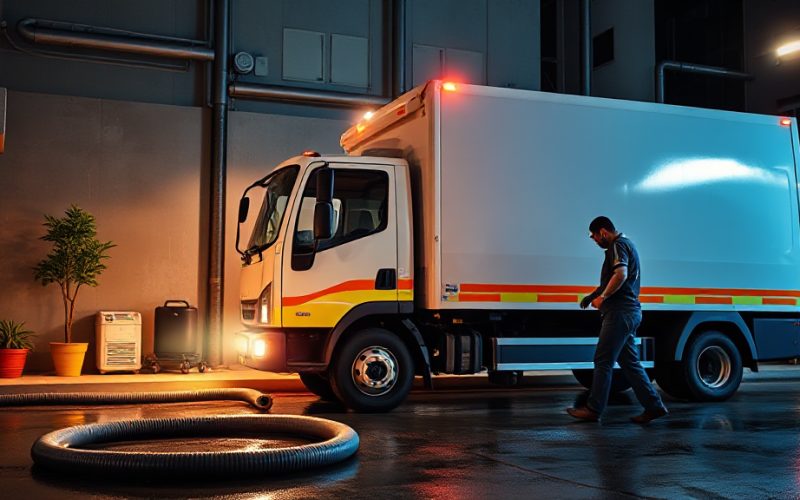
The crew from the desentupidora Santa Efigênia arrived with a van, a camera reel, and a hydrojetting hose. First they lifted the cleanout cap and looked at the water level. Slow drainage with standing water told them the blockage was downstream of the kitchen line.
They ran a camera first. That step matters because a blind rodding can push grease farther down and make the problem worse. The camera showed a grease mat about six meters in, exactly where the old cast-iron pipe flattened.
Then came the hydrojetting. The technician explained that high-pressure water cuts through grease and scale better than a snake on soft blockages. He worked in short passes, pulling the hose back slowly so the debris flushed toward the street main.
After the line ran clear, they tested with hot water from two fixtures at once. That is the check most people skip. A drain that looks clear under a trickle can still back up under a real load.
What I learned about timing and access
The whole job took under two hours, but only because the cleanout was reachable. In one neighboring building, the cleanout was buried under a tiled floor, and the crew had to open a small section of tile before they could start. That added hours and cost.
I now note the cleanout location on a label inside the utility room. It sounds trivial until the next backup happens at night and nobody can find the cap.
Lessons from the routine that I keep using
The biggest lesson is that preparation is not paperwork. It is physical: clear access, a known shutoff, and an honest history of the problem. A desentupidora em Santa Efigênia São Paulo SP can only move as fast as the site allows, and the site is my responsibility before the call.
Second, I stopped treating every backup as an emergency of the same size. A single slow sink is a different job from sewage rising in a ground-floor drain. Matching the response to the symptom avoids paying for heavy equipment when a simple rodding would do.
Third, I keep a short log after each visit: date, fixture, method used, and whether the line was camera-checked. Over a year, that log shows patterns. Two visits in the same quarter on the same line mean the pipe itself needs attention, not just another clearing.
Finally, I ask what preventive step fits the building. In older Santa Efigênia properties, that is usually periodic hydrojetting on kitchen lines and a grease trap schedule. Prevention is cheaper than emergency response, and the difference shows up in the log.
When the van pulls away, I do one last thing: I walk the route again and confirm the cleanout cap is tight and the floor is dry. That five-minute check is how the next call starts faster than this one did.
